Two decades ago, Australian Tennis Magazine covered a defining moment in Roland Garros history – the first of 14 Paris crowns for the Spaniard. Nadal was flashy and fearless in his ascent to Grand Slam glory, posing a new threat to the reign of Roger Federer.
At the same tournament 20 years on, fellow Spaniard Carlos Alcaraz won his fifth Grand Slam title at exactly the same age – 22 years, one month and three days old – as his idol Nadal.
The immediate impact was bad enough. Roger Federer had failed in his bid to join the elite group that had won all four majors during their careers – Fred Perry, Don Budge, Rod Laver, Roy Emerson and Andre Agassi.
What’s more, he’d failed in a manner that shocked his legions of fans by playing erratically in the semifinals of the French Open against Rafael Nadal on the Spanish left-hander’s 19th birthday.
READ MORE: Legends gather at Roland Garros to farewell Rafael Nadal
The possible long-term effects were more worrying. This was Federer’s seventh campaign at Roland Garros and the first time he’d been beyond the quarterfinals. Is he destined to follow in the footsteps of John McEnroe, Boris Becker, Stefan Edberg, Pete Sampras and other attacking players of the modern era who never found a way to overcome the topspin experts in their claycourt citadel?
And how much will the disappointment, following his Australian Open defeat, erode his confidence?
Nadal was making his debut at Roland Garros. He’d been raised on clay courts, however, and in two weeks had come to know the area like his own backyard. After ousting Federer, he duly went on to capture his first Grand Slam crown, though only after a terrific fight with Argentina’s unseeded Mariano Puerta. In the most gripping final for years, the 26-year-old Puerta, also a left-hander, drew the best out of Nadal as he lost gallantly 6-7(6) 6-3 6-1 7-5.
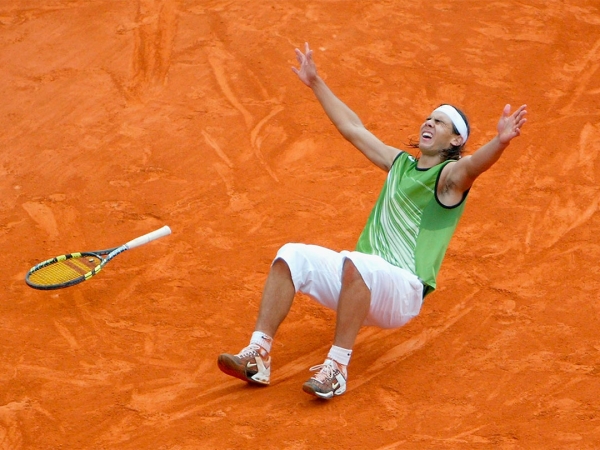
It was the first time since the teenage Mats Wilander succeeded in 1982 that a player had won the championship at his initial attempt. And it extended Nadal’s streak to 24 match wins, covering his earlier triumphs at Monte Carlo, Barcelona and Rome. Earlier still, he had triumphed on clay at Costa Do Sauipe in Brazil and in Acapulco in Mexico. In fact, he’d only lost two of his 40 claycourt matches all year.
But the real key to his meteoric rise from 51st to fifth in the rankings was his gutsy defeat of Andy Roddick in the Davis Cup final at Seville last December. That made him a national hero and boosted his already high level of self-confidence.
Federer, of course, was well aware of the stats and all the talk of the kid from Mallorca looming as a giant of the game. Despite his own tally of six titles in 2005, the gentlemanly Swiss player must have felt like a hunted animal, and in his confrontation with Nadal, he played like one.
For some reason, whether it was apprehension or nerves, a strong wind, or his opponent’s prodigious topspin – or a combination of all four – Federer made 62 unforced errors, an amazing total for a player of his stature. He mis-hit and over-hit shots, served inconsistently and, towards the end, planted a succession of forehands into the net. Nadal, too, had shaky moments, but the scoreline of 6-3 4-6 6-4 6-3 reflected his overall superiority.
In his moment of triumph, the lad was so struck by the enormity of his deed, his shattering of Federer’s dream, that he apologised. “I am so sorry for you,” he said, clasping the loser’s hand and looking solemn.
“No, no, no,” said Federer, putting his arm around Nadal’s shoulder. “You played very well. Good luck for the final. Good luck for the future.”
They were gracious words to a tough and hungry competitor who has now edged past Roddick, Safin and Hewitt as Federer’s most dangerous rival – and not only on clay. “I believe he’s going to be good on grass, too,” Federer said of Nadal. “The guys who make it to the top five can play on any surface.”
The world No.1 hadn’t dropped a set on his way to the semifinal, dismissing claycourt experts such as Fernando Gonzalez and Carlos Moya imperiously. With Tony Roche nodding approvingly in the stands, it all went smoothly. Perhaps too smoothly, because Federer might have benefited from one or two sterner tests.
Nor did anyone, except briefly, Frenchman Sebastian Grosjean, hold up Nadal.
The Spaniard’s big weapon is his fierce topspin, which he hits with an extreme Western grip. This, along with his left-handedness, strength, speed, agility, and awesome will to win, overwhelmed most opponents. All were frequently pushed back behind the baseline as they tried desperately to get over the rearing ball.
𝐌𝐚𝐲 𝟐𝟑𝐫𝐝, 𝟐𝟎𝟎𝟓
First round at Roland-Garros: Rafael Nadal vs. Lars Burgsmuller. Nadal on serve. Players ready? Let the legacy begin 🎾@RafaelNadal pic.twitter.com/jHBXES8cK8— Roland-Garros (@rolandgarros) October 11, 2024
Nadal’s demeanour was also intimidating. In his colourful outfit, he came on court with all the flamboyance of a matador. But then, after striding to his chair, he would dash on court, venting pent-up energy and seeming more like an angry bull than its tormentor.
During the umpire’s pre-match talk at the net, Nadal would bounce on his toes while staring fixedly at his opponent’s face. Often, he’d sprint to the baseline to begin a game. He was so fit, determined and exuberant, he looked unstoppable. And he was.